Fly tying is one of the oldest and most fascinating traditions in angling. Long before modern fishing rods, synthetic materials, and online tutorials, anglers were crafting artificial flies from feathers, wool, and natural fibers to imitate the insects fish feed upon. Today, fly tying remains a thriving craft practiced by millions of anglers worldwide.
This journey through the history of fly tying reveals how an ancient fishing technique evolved into a sophisticated art form and a cornerstone of modern fly fishing.
Ancient Origins of Fly Tying
The earliest known reference to fly fishing dates back nearly 2,000 years. Ancient Macedonian anglers reportedly used hooks wrapped with red wool and decorated with rooster feathers to attract fish.


4
These early artificial flies were simple, but they introduced a revolutionary concept that still drives fly fishing today:
Imitate natural prey to fool fish.
This principle became the foundation of fly tying and remains relevant in every modern fly pattern.
The Medieval Development of Fly Fishing
During the Middle Ages, fishing became increasingly important across Europe. Anglers experimented with different feathers, wool, silk threads, and animal fur to improve their artificial flies.
A major milestone occurred in 1496 with the publication of The Treatyse of Fysshynge wyth an Angle by Juliana Berners.
The book documented some of the earliest known fly patterns and provided instructions that influenced generations of anglers.
Materials commonly used included:
- Rooster feathers
- Wool yarn
- Silk thread
- Handmade hooks
These early patterns marked the beginning of systematic fly design.
The Rise of Classic Fly Patterns
By the 17th and 18th centuries, anglers began closely observing aquatic insects and fish feeding behavior.
This led to the creation of specialized fly categories:
- Dry Flies
- Wet Flies
- Nymphs
- Streamers
Instead of simply creating attractive lures, fly tiers started replicating actual insects found near rivers and streams.


4
The concept of “matching the hatch” emerged during this period and remains a key fly-fishing strategy today.
The Golden Age of Salmon Fly Tying
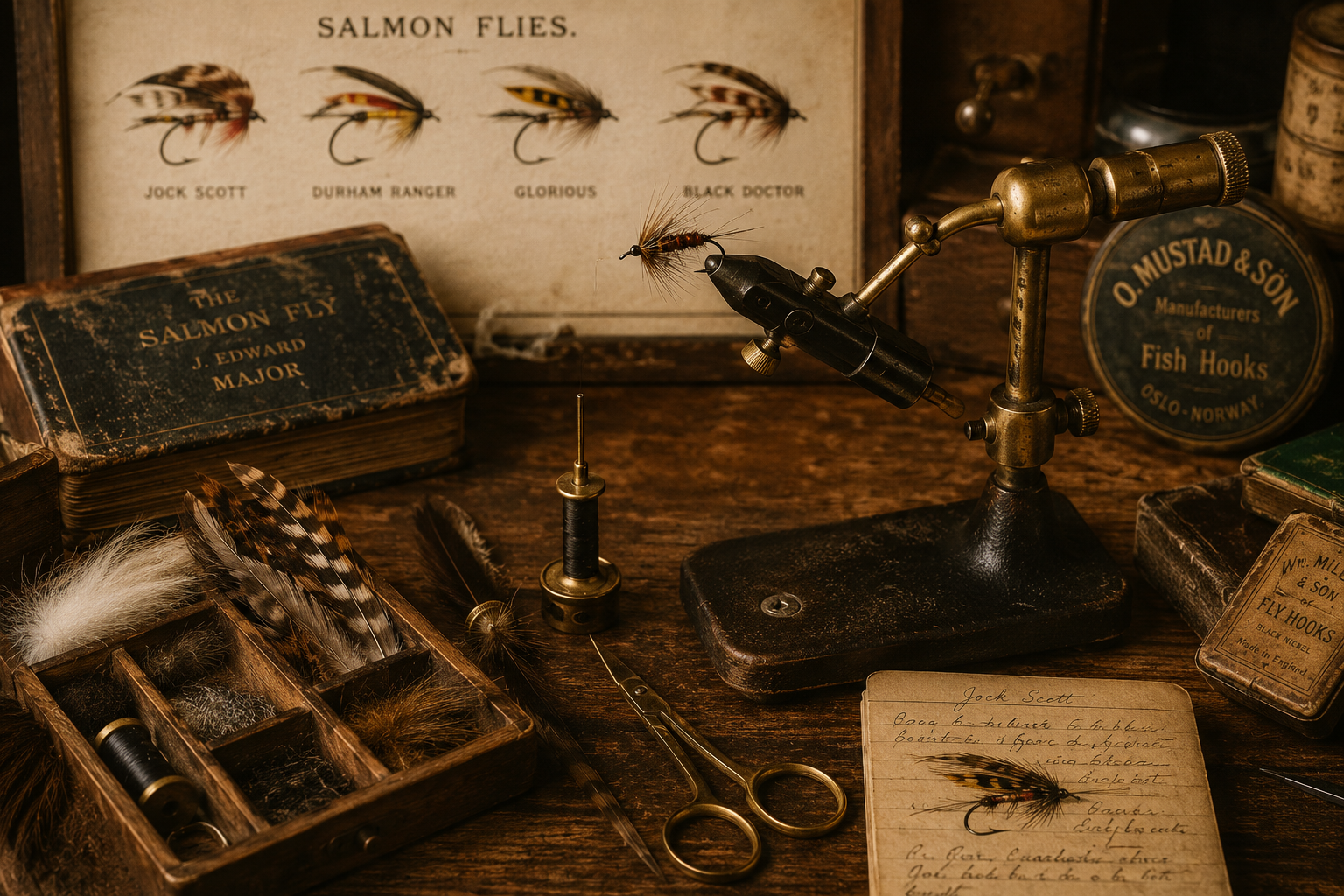
The Victorian era is often considered the golden age of decorative fly tying.
Anglers pursuing Atlantic salmon developed extraordinarily detailed patterns using exotic feathers sourced from around the world.
Popular materials included:
- Golden pheasant feathers
- Peacock herl
- Jungle cock feathers
- Macaw feathers
- Toucan feathers


7
Many of these flies were so intricate that they became works of art rather than simple fishing tools.
Collectors and fly tiers still recreate these historic patterns today.
Industrial Revolution and Mass Production
The Industrial Revolution transformed fly tying forever.
Manufacturing advancements introduced:
- Stronger hooks
- Improved tying threads
- Better fly tying tools
- Consistent material quality
For the first time, anglers could purchase purpose-built fly tying equipment rather than making everything themselves.
This era also laid the foundation for the modern fly-fishing industry.
Modern Fly Tying Materials
The twentieth century saw tremendous innovation in fly tying materials.
While traditional materials remained popular, synthetic alternatives began to appear.
Traditional Materials
- Rooster hackle
- Deer hair
- Rabbit fur
- Peacock herl
- Pheasant feathers
Modern Materials
- Flash fibers
- Synthetic dubbing
- Foam sheets
- Silicone legs
- UV reflective materials


4
These innovations allowed anglers to create more durable, realistic, and effective fly patterns.
The Digital Revolution in Fly Tying
The internet has changed fly tying more rapidly than any previous innovation.
Today, anglers can:
- Watch step-by-step tying tutorials
- Join global fly-fishing communities
- Purchase materials online
- Learn advanced techniques from experts
- Share fly patterns instantly
Social media platforms and video tutorials have introduced thousands of new anglers to the craft.
A beginner can now learn in months what once took years to master.
Fly Tying Today
Modern fly tying combines centuries of tradition with cutting-edge innovation.
Popular contemporary patterns include:
- Woolly Bugger
- Adams Dry Fly
- Pheasant Tail Nymph
- Zebra Midge
- Clouser Minnow


4
Today’s fly tiers have access to more materials, tools, and information than any generation before them.
Yet the fundamental goal remains unchanged: creating an artificial fly that convinces a fish it is real food.
The Future of Fly Tying
The future of fly tying is likely to be shaped by:
- Sustainable sourcing of natural materials
- Eco-friendly synthetic alternatives
- Advanced fly-tying tools
- 3D-designed accessories
- Global online learning communities
As technology advances, fly tying will continue evolving while preserving its rich heritage.
Conclusion
The history of fly tying is a remarkable story of creativity, craftsmanship, and innovation. From ancient Macedonian anglers wrapping wool around hooks to modern tiers using sophisticated synthetic materials, the craft has continually adapted while remaining true to its purpose.
Whether you’re tying your first fly or your thousandth, every fly connects you to a tradition that spans nearly two millennia. Understanding this history not only enriches your appreciation of fly fishing but also highlights why fly tying remains one of the most rewarding aspects of the sport.
SEO Keywords
History of fly tying, fly tying history, evolution of fly tying, traditional fly tying, modern fly tying, fly fishing history, artificial fishing flies, classic fly patterns, fly tying materials, fly fishing traditions, history of fly fishing, handmade fishing flies.